
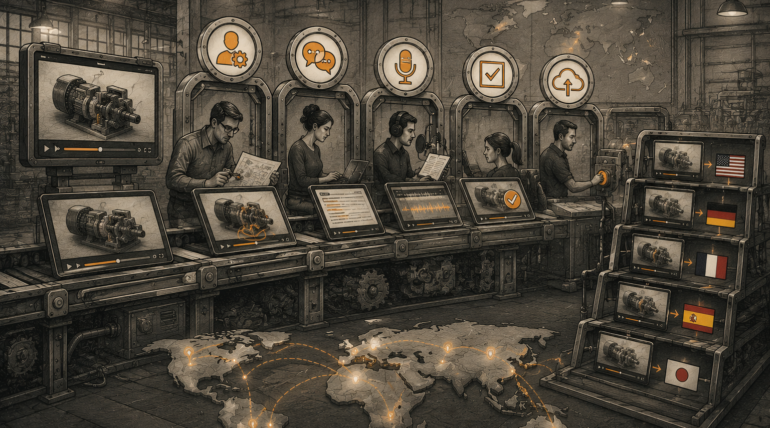
How to Localise Training Videos into 5+ Languages Without Losing Technical Accuracy
For global companies, training videos must be understood by employees across multiple countries. Localising into five or more languages is challenging, especially for technical content where accuracy is critical. Mistakes in translation can lead to misunderstandings, errors, or safety risks.
A well-planned localisation process ensures clarity, consistency, and retention of technical precision.
1. Identify critical content and languages
Start by determining:
- which sections contain technical terminology
- which languages are required for each region
- cultural or regulatory differences that may affect interpretation
Prioritizing content ensures that the most critical information is accurate in all languages.
2. Choose the right localisation method
Depending on your video type, you can choose between:
- Subtitles – quick to implement, cost-effective, preserves original audio
- Voice-over – provides native language narration while keeping visuals intact
- Dubbing – replaces original audio entirely, best for immersive experiences
Each method has pros and cons; the choice depends on audience preference, video length, and budget.
3. Use professional translators with technical expertise
Technical accuracy is crucial:
- hire translators who understand industry-specific terminology
- provide a glossary of terms and reference material
- involve subject-matter experts to review translations
This prevents misinterpretation and maintains the integrity of technical instructions.
4. Prepare the video for localisation
To simplify translation and adaptation:
- separate voice tracks from visuals
- use editable graphics and text overlays
- avoid culture-specific references that may confuse international audiences
Preparation reduces rework and ensures smooth integration of multiple languages.
5. Implement quality control
Check all localised versions for accuracy:
- have native speakers review and validate translations
- verify technical terms and step-by-step instructions
- test readability of subtitles and clarity of voice-over
A robust quality check prevents costly mistakes and ensures reliability.
6. Maintain consistency across updates
Training content evolves over time:
- update all language versions simultaneously
- maintain a version history for each language
- standardize style, tone, and terminology
Consistent updates protect technical accuracy and preserve user confidence.
7. Distribute efficiently
Make sure employees can access the right language version:
- integrate videos into LMS or internal portals
- provide language selection menus
- ensure offline accessibility for remote locations
Easy access maximizes engagement and reduces confusion.
Localising training videos into multiple languages without losing technical accuracy requires careful planning, professional translation, and rigorous quality control.
By choosing the right localisation method, preparing content properly, and maintaining consistency, companies can deliver effective, multilingual training that is accurate, engaging, and accessible for employees across the globe.
This approach reduces errors, enhances learning outcomes, and ensures that technical knowledge is conveyed correctly in every language.
(author: Martin Žilinčan 20. 04. 2026, updated 06. 08. 2026)
👉 Contact us – we will create a tailored video manual, from the script all the way through to language versions and distribution across all your markets.